 Sydney's near-ancient Genesian Theatre, on Kent, deserves more attention. After all, it was christened in honour of the patron saint of actors. And christened's the word, for this former church.
There we were, rammed against the back wall, in the loft, which, incredibly still affords a decent view. There, for something new, yet old, from the pen of Melvyn Morrow, whose name might tinkle, with reference to recent hits 'Shout!' & 'Dusty'; or Opera Australia, if you please.
This work seems to betray an abiding passion, if not obsession, for the very considerable work of Dickens.
Morrow has, I think, richly reimagined or, at least, extrapolated the lives of two of Dickens' sons, who spent most of their lives in Australia. As to just how faithful the text is to the text of their lives, I'm unsure.
One of the 'Aussie' brothers, Alfred D'orsay Tennyson Dickens (phew!), was, in actuality a great proselytiser of his father's work, giving lectures throughout Europe, the US and Australia. He was born, the sixth child and fourth son of the great man, towards the end of 1845, and was persuaded by his father, some 20 years later to emigrate down under. At the time, he was something of a notorious debtor and, from what I gather, something of an idle, spoilt brat, like his siblings.
In any event, Alfred was soon followed by his younger brother, Edward Bulwer Lytton Dickens, who rose through local government, in Bourke, to become the member for Wilcannia, in the NSW Parliament. He later lost his seat, to become a rabbit inspector, in Moree.
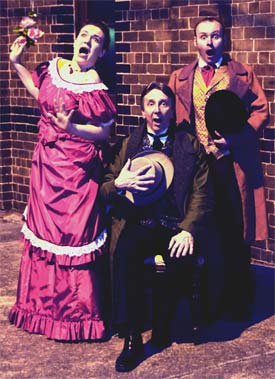
The way Morrow tells it, the two (who in the real world, apparently artistically talentless, teamed-up as stock and station agents), fallen upon hard times, became vaudevilleans, along with Edward's wife, Constance. This is the flimsy, but entertaining premise for a scholarly, but lighthearted traverse of Dickens complete works. (Well, maybe not. I don't recall any references to my sentimental favourite, Copperfield, for instance. But it was a nonetheless comprehensive selection.)
Director Roger Gimblett has ensured there are no loose ends in this slick, albeit a little too longish musical fancy. Momentum and timing did flag & falter, from time-to-time, but this was probably as much due to sluggish audience response, as much as anything. It was another sultry Sydney afternoon, in yet another under-ventilated old building.
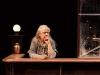
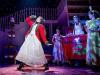
Keeping it all in the family, Owen Gimblett has developed an elegant, period set of surprising sophistication; especially so, given the likely tightness and inflexibility of budget. And Nicola Griggs has excelled with costumes, which are splendid.
Maria Okunev's musical direction is brilliant and indispensibly so, but her attempts, in her role as Constance, at English dialect are flawed and aggravating: forget about it! But with that brickbat comes a big bouquet, for her abilities at pianoforte, and operatic singing (a very tasty soprano); in these she could hardly be bettered.
Peter John-Layton, as Edward, has, at his best, quite a fine tenor; at his worst, it strays and is not up to the job of filling the space. Diction is also an issue. Moreover, his acting appears somewhat tentative, yet over-rehearsed, to the point of being stiff and self-conscious. It's all a bit by the numbers.
By contrast, Christopher Hamilton's Alfred is self-assured, seasoned and reflects a judicious reading of script, as well as a responsive ear and eye on the audience; the hallmarks of an experienced musical comedian and actor. His baritone, too, is very effective and attractive. When the two harmonise, it's sweet indeed.
I doubt this quite dense literary material will find the audiences of, say 'Shout!' But for Dickensians, it's a rare treat and tribute indeed; redolent with the larger-than-life cavalcade of immortal characters for which the man is so rightly revered, to say nothing of the playful and bawdy flavours of an equally well-researched repertoire of Victorian parlour ballads. As well, there are well-chosen extracts and excerpts from the works themselves.
DDU also provides some insights into Australia's nascent sociopolitical landscape, circa early 19th century. And we're reminded that very many of Dickens characters have an Australian connection. Magwitch, Micawber, Mr Jingle, The Artful Dodger, the Peggottys and Wackford Squeers: all were 'transported' by Dickens, to our much lower latitude.
And what better venue for the action than Dubbo School of Arts? Like the song says, we had a Dickens of a time. And the old ducks loved the singalongs. Well, ok, I did too.
Though Dickens himself never visited here, he had stronger affinity with Australia than, perhaps, is generally known, let alone acknowledged. As 'umble stock agents, Alfred and Edward mightn't have had his pretensions to literary pre-eminence, but there is some evidence, in the historical record, to suggest the spark might've been there, yet not fanned, to become a flame.
When Edward, as member for Wilcannia, rose to his feet in the NSW parliament, icnensed by the constant interjection of W.M. Willis, who represented the neighbouring constituency of Bourke, he's reported to have said, "Mr Speaker, my late, honoured father once wrote 'Barkis is willin'. If he'd been here tonight, he would have said 'Willis is barkin'." Touche!
The Genesian Theatre presents
Dickens Down Under: A Victoriana Vaudeville
by Melvyn Morrow
Director Roger Gimblett
Venue: Genesian Theatre | 420 Kent St Sydney
Dates: 21 November - 12 December 2009
Times: Friday and Saturday nights @ 8pm; Sunday matinee @ 4.30pm
Bookings: www.genesiantheatre.com.au